The cost of artificial grass installation per m² is rarely determined by the size of the area alone. Two 80 m² gardens can differ by several hundred euros depending on the artificial grass chosen, the condition of the ground, the preparation required, the shape of the space and how easy or difficult it is to access with materials and machinery.
That is why, when you search for a price per m², you will find figures that do not all refer to the same thing: some cover only the roll of artificial grass, others include installation over an already prepared base, while others refer to a complete project including removal of the existing surface, levelling, aggregate, membrane and finishing work. Comparing these figures directly means comparing different types of work.
Here we explain what is actually included in an artificial grass installation quote, what makes the price go up or down, and how to request prices that you can genuinely compare.
First Things First: What Price Are You Comparing?
Most of the confusion comes from this. There are three very different ways of quoting a price per square metre:
- Material only. This is the price of the roll of artificial grass. It does not include labour, the base, joins or fixings. It is the lowest figure you are likely to see and the one that tells you the least about what you will actually pay in the end.
- Material installed over a prepared base. This includes the artificial grass, cutting, joins and fixing, but assumes that the surface is already ready: a terrace in good condition, a level concrete base or previously prepared ground.
- Complete project. This includes all of the above plus ground preparation: removal of the existing surface, levelling, compaction, aggregate, weed-control membrane and perimeter finishing. This is the price that really answers the question: “How much will it cost to have everything completely finished?”
What Is Included in an Artificial Grass Installation Quote?
| Item | What It Includes | When It Applies |
|---|---|---|
| Removal and Clearance | Removal of natural grass, roots, gravel or existing paving, including disposal of the waste. | Almost always in gardens; rarely on terraces |
| Excavation and Ground Reduction | Lowering the ground level as required so the base can be installed without the artificial grass ending up higher than the kerb or porch. | On soil |
| Levelling and Compaction | Creating a flat, stable surface with the correct gradients. | On soil |
| Aggregate Base | Sub-base aggregate and a levelling layer of sand or marble dust. | On soil |
| Weed-Control Membrane | Geotextile barrier installed beneath the artificial grass. | On soil or gravel |
| Artificial Grass Supply | The chosen product, including its roll width and pile height. | Always |
| Installation | Setting out, positioning the sections, cutting, joining with seaming tape and adhesive. | Always |
| Perimeter Fixing | Nails, staples, adhesive or edging profiles depending on the surface. | Always |
| Silica Sand | Ballast and fibre support where required by the product or intended use. | Depending on the product and use |
| Final Brushing and Cleaning | Brushing the fibres upright and leaving the area clean. | Always |
| Labour and Travel | Installation team, equipment and logistics. | Always |
What Does the Price Really Depend On?
The artificial grass itself is one of the elements that can vary the most. There can be a significant price difference between a basic model and a higher-end option. It is not just the appearance that changes: density, fibre type, yarn structure, backing and resistance to UV radiation all play a part.
Soil, Concrete or Tiles: Why They Don’t Cost the Same
On soil, most of the work takes place underneath. The existing surface needs to be removed, the ground level reduced, the area levelled and compacted, and a stable aggregate base created with the correct gradient. If this base is not properly prepared, sinking and water pooling can occur no matter how good the artificial grass is.
On concrete or tiles, there is no excavation, but the condition of the existing surface is crucial. The current gradients need to be checked, drains and water outlets must remain unobstructed, the grass must be fixed without damaging the waterproofing, and the finishing details around walls, steps and edging profiles need to be carefully handled.
As a general rule, installation over a hard surface in good condition is more economical because there is no need for excavation or groundworks. However, if the terrace has incorrect gradients, problematic expansion joints or poorly designed drainage, the price difference becomes smaller.
Why Two 100 m² Gardens Can Cost Different Amounts
Project A. The ground is already level, there is no vegetation to remove, access is direct from the street, the area is rectangular and consists of a single section. The base can be prepared quickly, the artificial grass requires very few joins and there is hardly any cutting. The price per square metre is therefore lower.
Project B. The garden has existing natural grass, roots from two trees, a sunken area next to a wall, access only through the house, and a perimeter with planted beds and a swimming pool. The work involves removal, waste disposal, adding fill material, compaction, constant cutting and leftover material that still has to be paid for.
Same area, same product, very different quotes. That is why, when someone gives you a price per square metre without having seen the space, they are giving you an estimate, not a quotation.
And that is also why comparing two offers based only on the €/m² can lead you to choose the one that includes the least.
How to Calculate the Square Metres Without Underestimating
- Measure the length by the width. For rectangular areas, this is sufficient.
- Divide complex shapes into sections. Break the garden down into rectangles, triangles and semicircles, calculate each area and add them together.
- Always measure the widest point. In irregular areas, use the maximum width: artificial grass is cut to size, and material that cannot be used efficiently becomes waste.
- Take the direction of the sections into account. All sections must be laid in the same direction to ensure a consistent colour, and this affects how the roll can be divided.
- Allow an additional margin. It is advisable to add a percentage to the net surface area to account for cuts, joins and overlaps. In very irregular gardens, this allowance may need to be considerably higher.
Price and Quality: Why Two Similar Artificial Grass Products Can Cost Different Amounts
At first glance, especially in a photograph, most artificial grasses look quite similar. The differences tend to become apparent after two or three summers:
- Fibre quality and shape, which determine how the grass feels and how it performs underfoot.
- Recovery, meaning whether the fibres spring back after use or remain flattened in high-traffic areas.
- Density, which affects appearance, the feel underfoot and the product’s lifespan.
- Protection against UV radiation, particularly important in areas with high sun exposure.
- Drainage and backing, which affect how efficiently water drains away and how the grass performs in gardens with pets.
- Installation quality, something you will not find on a technical data sheet but which determines whether the joins remain virtually invisible after a year.
What Changes on the Costa del Sol?
On the Costa del Sol, artificial grass is exposed to year-round use and high levels of sunshine. This affects two key decisions in the quote: the fibre’s protection against UV radiation, which is particularly important for south-facing areas and surfaces with no shade, and drainage, as many installations are on terraces, penthouse roof terraces and around swimming pools, where water needs to flow towards the existing drainage points.
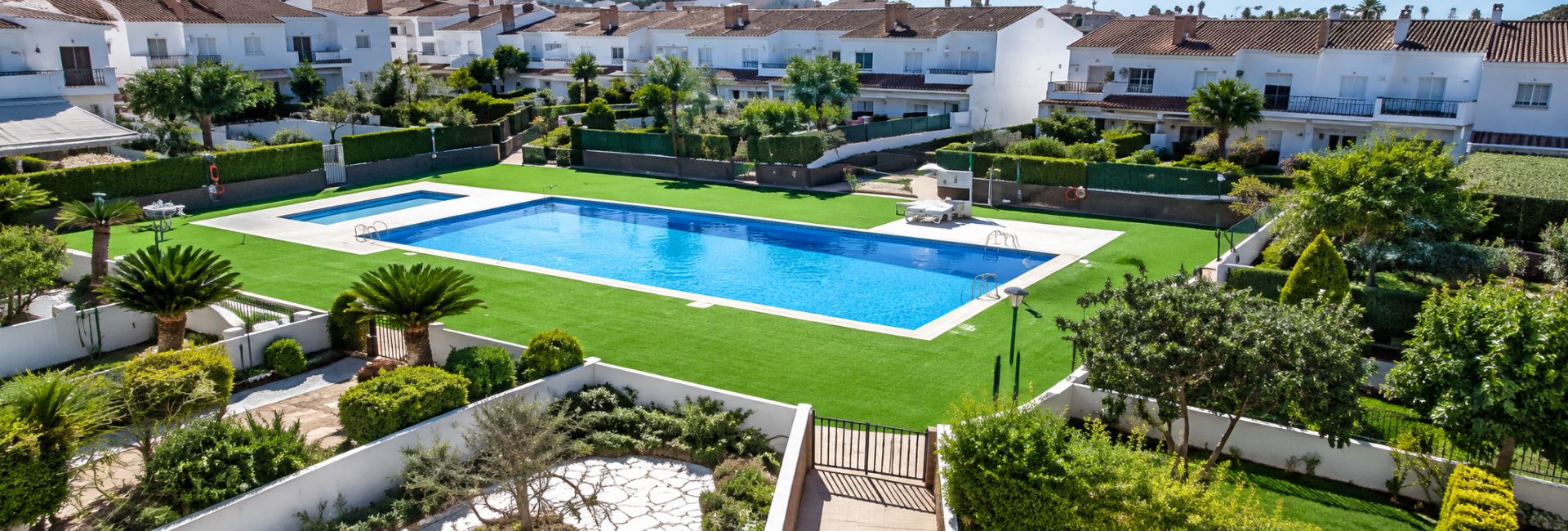
In villa gardens and communal areas of residential developments, there is also the added benefit of reduced water consumption and less regular maintenance. This often changes the way the overall cost is viewed: it is not only about what the artificial grass costs to install, but also about the ongoing costs it can eliminate each month.
How to Request a Quote You Can Genuinely Compare
- Approximate surface area in square metres.
- Photographs of the space, including the access.
- Location.
- Current surface type: soil, natural grass, tiles, concrete or gravel.
- Intended use and level of foot traffic.
- Whether there is a swimming pool.
- Whether you have pets.
With this information, we can provide a more reliable price estimate and, after the site visit, prepare a fixed, itemised quotation. Our artificial grass installation service explains what each job includes, so you can compare our proposal properly with any other quotation.